What the record-low water level unveils in Budapest
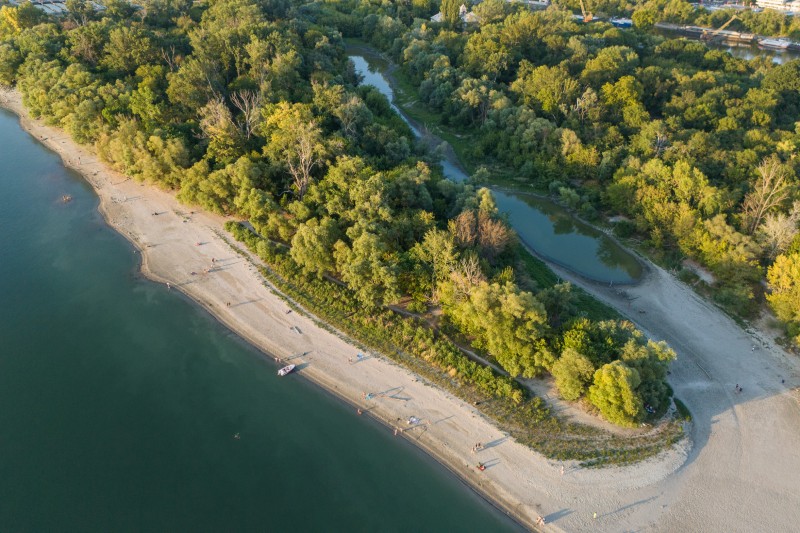
As the heat of August 2026 continues to hold Central Europe in its grip, the Danube has retreated to historic lows, reaching levels not seen in decades. While the receding waters present challenges for navigation, they have also gifted Budapest with a rare, fleeting archaeological spectacle.
The river is “breathing out,” exposing a hidden world of shipwrecks, ruins, and artifacts that usually lie buried beneath meters of silty water. For a few weeks only, the city has become a living museum. Here is what has emerged from the depths.
Photo: Unknown
1. The Ínség-szikla: The “Rock of Desperation” emerges
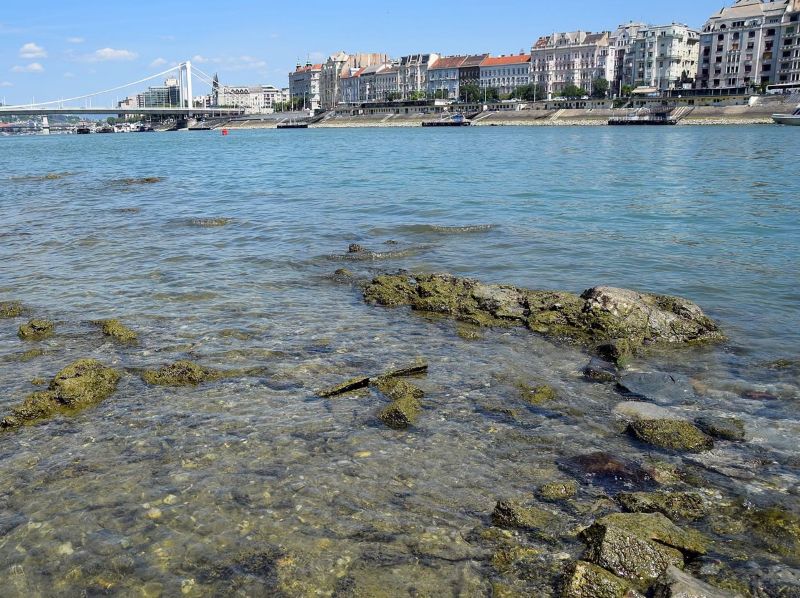
Photo: Anna Schwelung
Located at the foot of Gellért Hill, near the Liberty Bridge, the Ínség-szikla (Rock of Desperation) is perhaps the most famous omen of a dry summer. Usually completely submerged, this jagged natural formation only appears when the water level drops below 95 centimeters.
Its name, which translates to “Rock of Adversity” or “Drought Rock,” stems from a time when low water meant failing crops and famine. Today, it serves as a fascinating landmark for locals and tourists alike. Seeing the rock fully exposed, now surrounded by people taking photos, is a stark reminder of the power of the elements.
2. Echoes of the past: 1945
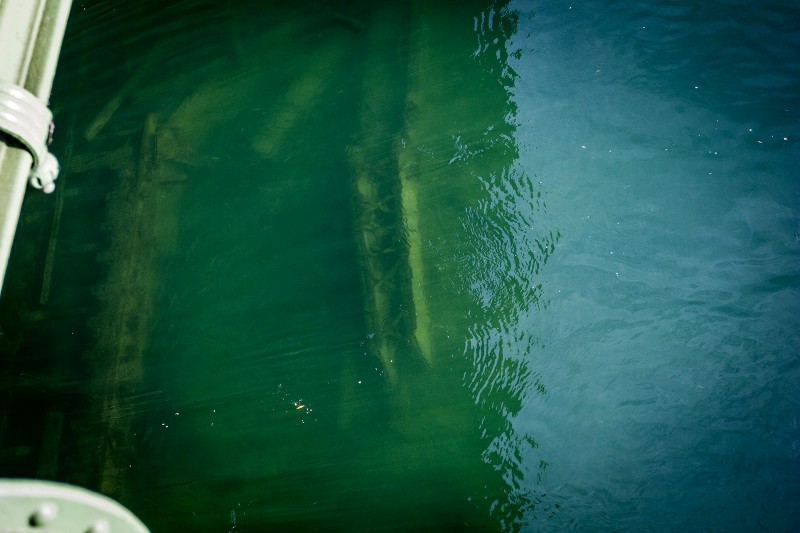
Photo: Mervai Márk
While the Liberty Bridge (originally the Franz Joseph Bridge) stands proudly today, its history is marked by the tragedy of World War II. In January 1945, retreating German troops blew up the bridge’s central spans.
With the current low water levels, structural remnants of the original bridge have become visible near the Buda pylons. Tangled railings, rusted rivets, and twisted steel beams that plummeted into the river eight decades ago are now breaking the surface. These artifacts offer a haunting, tactile connection to the Siege of Budapest that few ever get to see.
3. The Margaret Bridge “Peninsula”
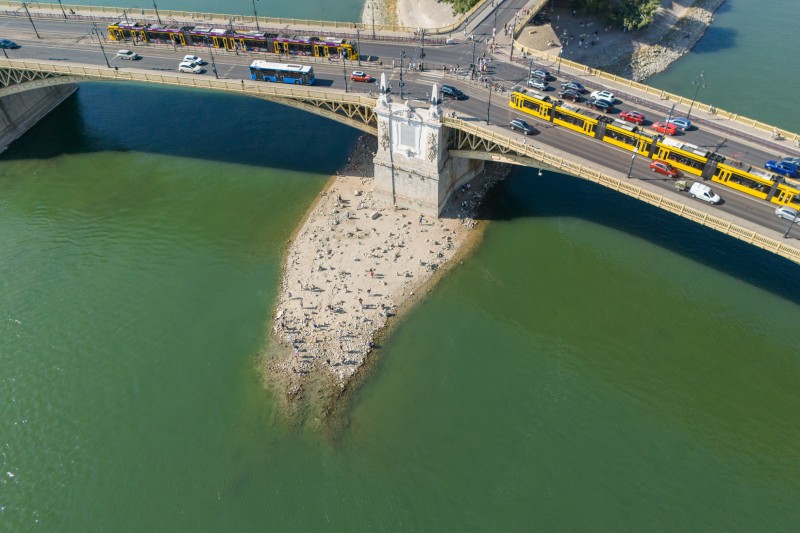
Photo: Unknown
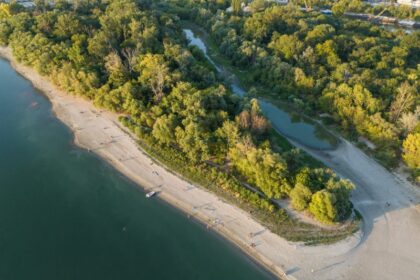
At the southern tip of Margaret Island, the receding river has created a temporary landscape feature: a vast gravel and sand peninsula stretching out toward the Margaret Bridge.
What is usually a deep, swirling current has transformed into a walkable beach. Locals have flocked to this “pop-up” island to walk out into the middle of the riverbed, offering a perspective of the Parliament and the Buda Castle that is usually only available to sailors. It has become the city’s most exclusive (and most temporary) picnic spot.
4. Dangerous History: Unexploded bombs
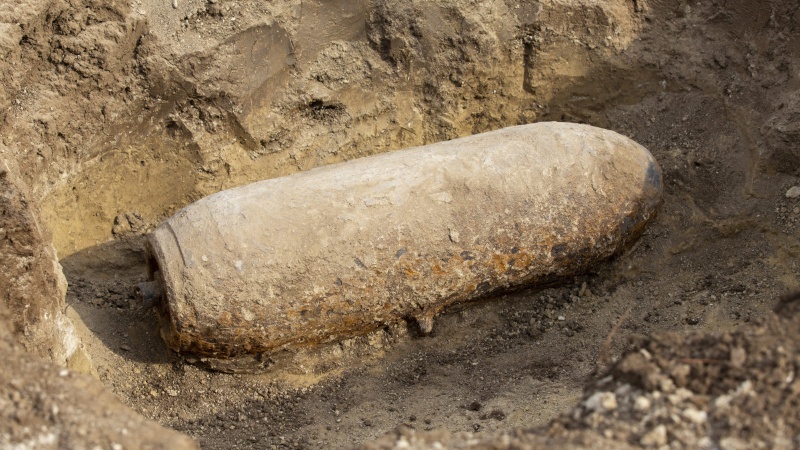
Photo: Varga György
Low water levels are not always a celebration of history; sometimes, they are a safety concern. The Danube’s bed is still home to a significant amount of unexploded ordnance (UXO) from WWII.
In recent weeks, several Soviet and German river mines and aerial bombs have been spotted by hikers and enthusiasts on the exposed riverbanks. The Hungarian Army’s bomb disposal units have been working overtime to secure these sites. A Note to Travelers: If you spot something metallic and unusual in the mud, do not touch it! Notify the authorities immediately.
5. Traces of displaced cemetery
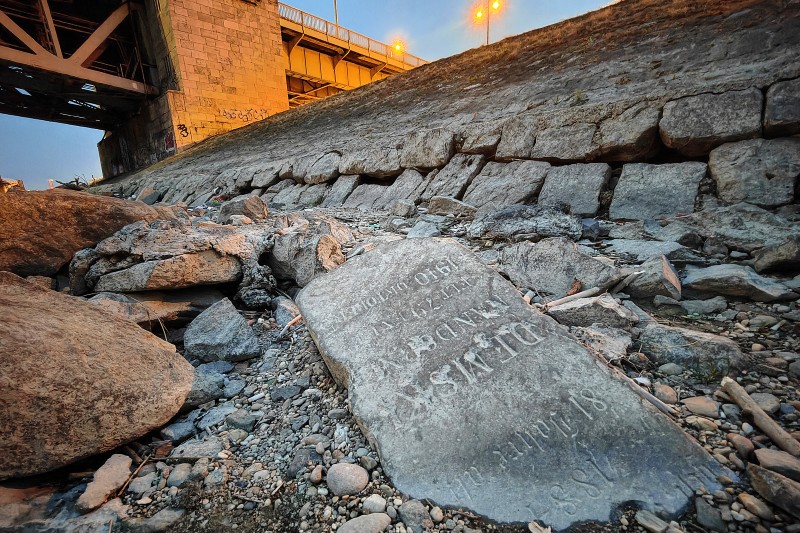
Photo: Nagy Attila Károly (rtl.hu)
Probably the spookiest entry on our list is remnants of a former cemetery. The Németvölgyi Cemetery (once located in what is now the 12th District) was one of Budapest’s primary burial grounds until it was closed in 1912 and eventually liquidated in the mid-20th century to make way for urban development (including the current MOM Park area).
In a move that feels shocking by modern standards, the high-quality marble and limestone gravestones from the abandoned cemetery were broken up and sold as “industrial stone.” During the post-war reconstruction and the reinforcement of the Danube embankments in the 1960s, these stones were used as riprap, the heavy material used to prevent soil erosion along the river.
When the Danube drops to record lows, these stones break the surface. If you look closely at the “rocks” near the base of the Petőfi Bridge pylons, you can see the polished surfaces of marble, carved decorative borders, and even fragments of names and dates etched into the stone. These “tombstones” serve as a quiet, underwater memorial to the generations of locals whose final resting places were repurposed to protect the city from the very river that now reveals them.
With this last, chilling entry we conclude our list of interesting finds. Even though the low water level provides interesting strolls along the riverbed, still we pray for more precipitation north, to raise the water of the Danube. We wish you safe sailing wherever you are.

 Sightseeing Cruise – Departure from Pest – from € 12
 Sightseeing Cruise – Departure from Buda – from € 12
 Budapest Sightseeing with Drink Included – from € 19
 Cheers to Vibes: Zero Alcohol Cruise – from € 19
 COMBO TICKET: Thermal Bath Pass & Sightseeing cruise – from € 32
 4 Course dinner cruise – from € 77
 4 Course Dinner Cruise & Folklore Show – from € 91
 Unlimited Mulled Wine Cruise from € 21
 Unlimited Prosecco cruise – from € 27
 Drink & Folklore Show – from € 47